Friday, May 6, 2011

Why Evolution Matters Now

Today watched a segment from the PBS Evolution series, titled "Why Evolution Matters Now."


Homework: Tomorrow you will have a short in class writing assignment, that will count for a quiz grade where you will need to answer the question:

Give two examples of ways in which genetic variation and environmental factors are causes of evolution and the diversity of organisms. You will need to define evolution and state the four essential components of natural selection. You will be given these questions on paper to guide your answers. You will NOT be able to use your notes.

Thursday, May 5, 2011

Quick Evolution Leads to Quiet Crickets

Over the past week, we have been addressing the learning standard that students should be able to:

Give examples of ways in which genetic variation and environmental factors are causes of evolution and the diversity of organisms

We learned about the fictional clipbirds which serve as a model for Darwin's finches. Charles Darwin was under the impression that evolution happens so slowly, we can't actually see it happen in a lifetime. While this idea is correct in many instances, there are some cases where organisms reproduce in a short time period, for example bacteria and crickets.

Today we read the article "Quick Evolution Leads to Quiet Crickets."

Attack of the flesh-eating parasitoid maggots!! Mutant mute crickets run rampant in tropical paradise!! The headlines may sound like a trailer for a cheap horror flick — but in fact, these sensationalist sound bites accurately describe the situation on the Hawaiian island of Kauai. The "flesh-eating parasitoid maggots" are the offspring of the fly, Ormia ochracea, which invaded Hawaii from North America, and the mutant crickets are the flies' would-be victims. The flies follow the chirps of a calling cricket and then deposit a smattering of wriggling maggots onto the cricket's back. The maggots burrow into the cricket, and emerge, much fatter, a week later — killing the cricket in the process. But this fall, biologists Marlene Zuk, John Rotenberry, and Robin Tinghitella announced a breakdown in business-as-usual in this gruesome interaction: in just a few years, the crickets of Kauai have evolved a strategy to avoid becoming a maggot's lunch — but the strategy comes at a cost... To read more click here.

For homework answer the three questions at the bottom of the last page of the packet.

Wednesday, May 4, 2011

Clipbirds Lab

Today students did the Clipbirds Lab to see how evolution and availability of resources work together.

Homework: Due Friday
You are a news reporter and are writing a story on Charles Darwin and his theory.
You need to answer the questions of
Who was Charles Darwin?
What did he do and what were his discoveries?
When did do his research?
Where did his travels take him?
Why were his discoveries significant?
How has Darwin's discoveries shaped the current scientific view of evolution?

Important Notes:
You must cite at least three sources. No more than one of these can come from a wiki link. You must include the entire url. If you do not have proper citations, you will not receive credit for your work. You should use a combination of direct quotes and paraphrasing.

You can cite YouTube videos.

Not sure where to look? Below are some resources to get you started.
PBS's Evolution Series
Christ College's (Australian University) Darwin for Kids

Your article should use size 12, Times New Roman Font with 1.5 spacing.
You should write your article in a question & answer format.

Tuesday, May 3, 2011

Galapagos Exploration

Darwin was particularly inspired by what he saw, with regard to species, on the Galapagos islands. To help get us inspired, we watched segments of the IMAX film Galapagos Experience.

Tomorrow we will be doing a simulation that mimics what occurred in Darwin's finches (pictured below).

For Homework: Write a paragraph explaining why you think there is genetic variation in the bird beaks below. What advantages are there to such variation? Are there any disadvantages? Do you think one beak size (1,2,3 or 4) or is the best beak to have?

Monday, May 2, 2011

Welcome Back!

It's hard to believe, but as of today we only have three and a half weeks of school left! Our last unit of the year will be on evolution. What is evolution? In it's most basic form, evolution is change.

Today students completed a "what I know, think I know and want to know" brainstorm table as well as watched the video clips below.

It's important to know the difference between a hypothesis and a theory:


Who was Charles Darwin?


For homework, watch the video clip below and define the four components of natural selection.

Wednesday, April 13, 2011

Genetic Difference

Today we learned about characteristics that are inherited (come from nature) and those which are shaped by our environment (nurture). We also learned about blood types and how parents can have different blood types than their children.

Click the picture to link to the website we used to watch two short video clips and take a quiz on "nature vs. nurture."

Lastly, we started a segment from the BBC's four part documentary on "The Human Face." On Friday you will find out if the little girl with moebius syndrome had a successful surgery. If you are interested in continuing to watch the series on your own, that's great! But PLEASE don't ruin the surprise for the rest of the class. Thanks :)

Monday, April 11, 2011

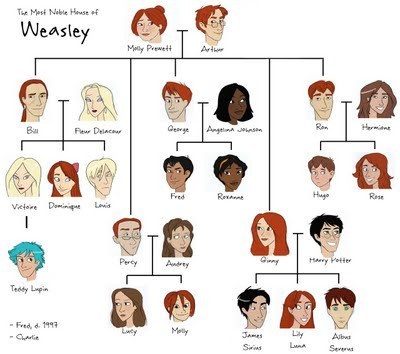
Today, with our 5th grade visitors, we learned about Pedigree charts. We used the Weasley's family tree to look at how the trait for red hair is passed down through their family.


It's a lot of work to actually draw people on a pedigree, so instead, scientists use symbols.


Above is the pedigree for Queen Victoria's family. It traces the trait for hemophilia. A disease where the blood does not clot.


Homework: Read and take notes on the information below. You will have a 4 question reading quiz on this information at the start of class. Three questions will be definitions and one question will ask you to THINK!

An excerpt from ExploringNature.org's explanation on genetics

Gregor Mendel, was a monk in Austria in the mid-1800s who raised peas in the monastery gardens. While breeding his peas, he made some big discoveries. They were discoveries about genetics.

The peas had several traits he could see. Some plants were tall and some were short. Some had wrinkled pods and some had smooth pods. Some pods were green and some where yellow. The flowers were white or purple. Mendel looked at each trait and learned how they were passed down to the offspring plants. Since plants breed using pollen, Mendel controlled which plants pollinated other plants. This was how he discovered many important genetic rules.

How an individual looks and what their genetic code is sometimes do not match up. This is the difference between genotype and phenotype. The genotype is the actual genetic make up of an individual. The phenotype is what that individual looks like.

Traits that show up more often are called dominant traits. Traits that show up less often are called recessive traits. If an individual with dominant traits breeds with an individual with recessive traits, this can result in a hybrid offspring. Hybrid individuals can look like they have dominant traits (phenotype), but actually be hybrid (genotype).

Hybrid plants are different from dominant plants even if they looked the same. Each gene has two chances at a trait – two copies — two alleles. So a hybrid plant could be carrying the allele for a recessive trait even if you can’t see it. So, for example, a hybrid plant might be tall like its dominant parent, but it still could have an allele for shortness that you don’t see. This is the difference between genotype and phenotype. The genotype is the actual genetic make up of an individual. The phenotype is what that individual looks like.

This can be illustrated with a simple chart. It’s called a Punnett’s Square.